
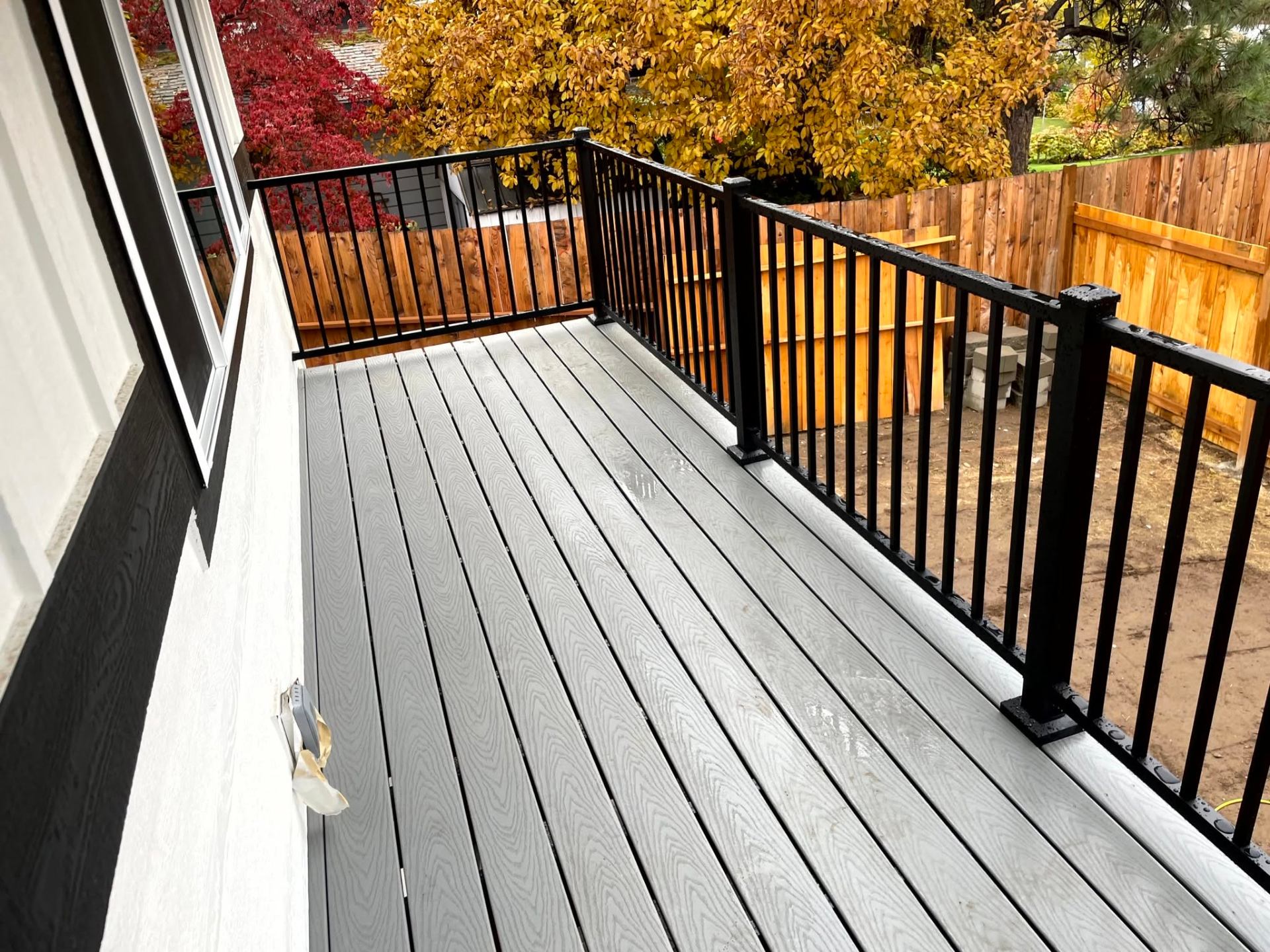
What our climate does to a deck surface
We get long stretches of intense, dry summer sun, followed by winters with snow load, moisture, and repeated freezing and thawing. On a timber deck that combination is relentless. Sun breaks down the surface and fades the stain, dry heat opens checks and splits along the grain, then winter moisture soaks into those open checks and freezes. Water expands as it freezes, so every cycle widens what the sun opened. That is why a stained cedar or treated deck here needs attention every year or two rather than every decade.
Capped composite decking changes the failure pattern. The board core is a wood-flour and polymer blend and the outer cap is a solid polymer shell wrapped around it, so the surface does not drink water and there is no grain to split along. Freeze-thaw has far less to work on, UV fade is engineered into the cap and warrantied by good manufacturers, and the boards do not splinter underfoot. It is not indestructible, but it fails slowly and predictably instead of visibly deteriorating every summer.
Heat, color and sun exposure
The one honest complaint about composite in a climate like ours is surface temperature. Dark boards in unshaded afternoon sun get hot enough to notice barefoot, and that is true of dark surfaces generally, including dark stained wood and dark pavers. The fix is planning, not avoidance.
Start with orientation. A deck facing west or southwest takes the worst of the afternoon in July, and that is where we steer clients toward the lighter grays, weathered browns and tan tones rather than the near-black options. North and east exposures, or decks under mature shade trees, can carry the dark dramatic colors comfortably. Boards that spend the hot hours in shade stay reasonable whatever their color.
Then plan shade into the structure rather than adding it later. A pergola over the seating zone, a solid cover over the outdoor kitchen and dining area, or a shade sail over the west end all turn a deck from an early-evening space into an all-day space. We size posts and footings for that cover at framing time even when the cover comes in a later phase, because retrofitting adequate footings under a finished deck is the most avoidable expense in this whole category of work.
Profile matters too. Grooved boards with hidden fasteners give a clean surface with no exposed screw heads to heat up or work loose, while square-edge boards face-screwed with color-matched fasteners are the right call on stair treads, picture-frame borders and anywhere the edge is exposed. Deep embossed grain hides scuffs and dust better on a hard-use family deck. Multi-tone streaked boards read more natural at a distance and hide pollen, pine needles and orchard dust between cleanings.
Living with it: maintenance and winter
Maintenance is genuinely light and it is worth being specific about what it is. Sweep the surface, particularly the gaps between boards, because trapped needles and leaves hold moisture against the frame below. Wash the deck once or twice a season with warm soapy water and a soft-bristle brush, working along the board length. Rinse thoroughly. Clean grease from grilling and tannin from fallen leaves or fruit reasonably promptly, since anything left to bake in for a season is harder to lift.
Skip high-pressure washing. A power washer at close range and high pressure can mar or streak a polymer cap and it can drive water where you do not want it. If you use one, use a wide fan at low pressure and keep the tip well back. Skip acid cleaners and abrasive pads, and skip solvent-based stains and sealers entirely: composite has nothing to absorb them.
In winter, snow can simply sit on the deck. If you want to clear it, use a plastic shovel and push along the boards rather than across them, leaving the last thin layer instead of scraping to the cap. For traction, sand or a calcium chloride ice melt is safer than rock salt, and rinse the residue off in spring. Keep the ground under an elevated deck draining and free of piled debris, because standing water under a deck is a problem for the framing and the house regardless of the surface above it.
The reason we pair composite with a properly built sub-frame, often steel, is simple: a surface designed to last decades deserves a skeleton that will not fail first. Composite on a frame that cups and twists will squeak, lift fasteners and look wrong long before the boards wear out. Get both right and the deck stays flat, quiet and low-maintenance for the life of the house.
The short version
- • Capped composite does not split or soak up water, so freeze-thaw has much less to attack than on stained timber.
- • Choose lighter colors for unshaded west and south exposures, and plan pergola or cover shade into the structure early.
- • Grooved boards with hidden fasteners for the field, square-edge with matched screws for stairs and borders.
- • Maintenance is sweeping, clear board gaps, and a soapy wash once or twice a year. No sanding, staining or sealing.
- • Plastic shovel along the boards, calcium chloride or sand instead of rock salt, and no high-pressure washing.
Frequently asked
Does composite decking get too hot in Wenatchee summers?
Any decking surface in full afternoon sun gets hot, and dark composite gets hotter than light composite. Two things fix it in practice: choose a lighter color for decks with unshaded west or south exposure, and shade the areas where people stand barefoot with a pergola, cover or awning. Deck boards in shade stay comfortable regardless of color, which is why we plan the shade structure and the board color together.
How does composite handle snow and freeze-thaw?
Capped composite does not absorb water the way wood does, so freeze-thaw cycles are not splitting and cupping the surface the way they work on a stained timber deck. Snow can sit on it or be shoveled off with a plastic shovel pushed along the boards. Avoid metal blades and rock salt, use a calcium chloride ice melt or sand if you need traction, and keep the gaps between boards clear so meltwater drains instead of pooling.
What maintenance does a composite deck actually need?
Sweep it, keep the board gaps and the area under the deck clear so water drains, and wash it once or twice a year with soap, water and a soft brush. Clean food, grease and leaf tannin spills reasonably soon rather than letting them sit. There is no sanding, staining or sealing, and there should not be any pressure washing at high pressure, which can mar the cap. That is the whole list.
Helpful reading: Custom deck building, Outdoor kitchens
Questions about your own project?
Call Garrett and talk it through. Serving Wenatchee, East Wenatchee, Cashmere, Leavenworth, Chelan and the rest of Chelan and Douglas counties.